Monthly Archives: March 2011

Dialogue…

I’ve received some private comments regarding the frame failure via email…

I’m all good with private messages.  Matter of fact, I really look forward to them.  However, I would like to remind you I’ve set this blog up to accept replies. At the end of each entry, there is a link appropriately named “Leave a comment”.  When clicked, you will be prompted with your name, email address (don’t let that worry you) and your comment.  The email address stays private and will not be used to do any spam mailings.  Your comment will then be put on a queue and will be moderated, with a reply from me.

The emails I have received would have made an excellent “conversation” that would have in turn been of interest to others.  My goal here is not to compete with the full blown forums (that would be way too ambitious).  Instead, I’m hoping we can establish some type of dialogue where folks can read and ask about some of the experiences I’ve gone through on this endevour of mine.  After all, if you didn’t find this of some interest you would not be here in the first place!  😉


Frame Failure – Continued

In an earlier post, I described bowtie6‘s frame failure.  Today, I have some pictures of the “issue”.  First, a little background…
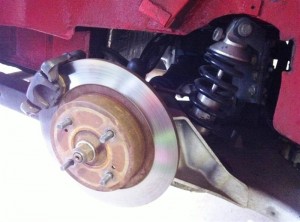
Rear suspension
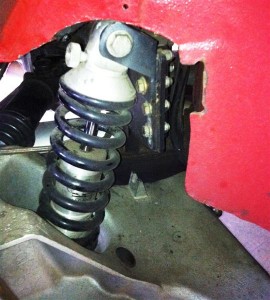
Rear suspension closeup

Soon after bowtie6‘s initial dismantling the frame was carefully inspected.  Although the frame was in excellent shape the rear differential mounting pins showed typical TR6 wear and tear: two of the four differential mounting pins were cracked.

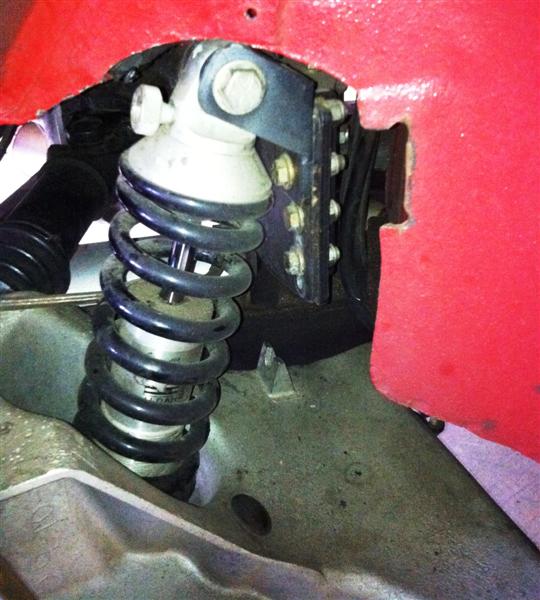
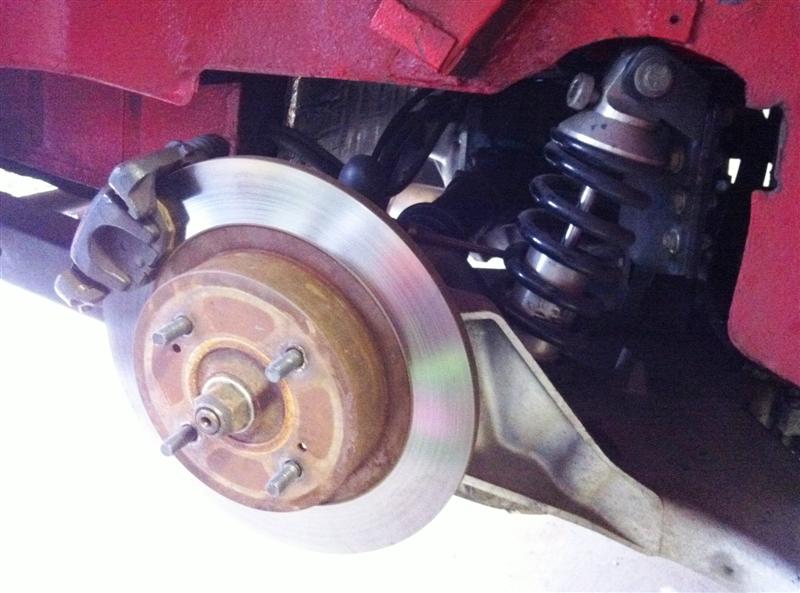
Since a bigger engine was to be installed, we reconfigured the rear suspension.  A completely redesigned mount was made to hold the Nissan R200 differential as well as the coilovers that would replace the lever action shocks and springs.

The pictures on the right show the rear suspension from the passenger’s side.  You can see the coilovers, rear disc brakes and the suspension mount holding the top coilover perch.

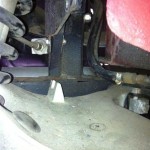
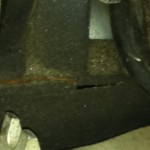
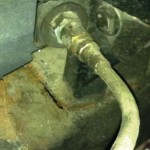
This brings us to the following photo gallery showing the frame damage.  The frame rail has suffered a serious, unrepairable stress crack.  I have inspected the driver’s side and there too, I can see a stress fracture although it is not as severe as the one on the passenger’s side.

I’m sure there will be plenty of critics analyzing the frame failure from these pictures and coming up with all kinds of root causes for the failure.  Quite frankly, the thing is what it is.  I got 15,000 from what I thought was a very good frame but this endevour has proven to be more than this frame could handle.  The extra power the engine gained from the cam and head work plus the stress of getting hammered by the control arms caused the frame to eventually expire.  Since the rear failed this extensively, I have reason to believe other parts of the frame have also suffered stress.

As soon as the frame comes out again to see the light of day, I plan to do a full autopsy by cutting it up and documenting stress points, failure points and basically show where the frame held up and where it did not.  I’ll have that in a future article which should be very interesting to read.

And now for a little reflecting…

These frames are now 35-40 years old.  These frames are also marginal at best.  Sure, with the anemic tractor engine on the stock TR6 the frame will probably last, but not by much.   However, if anyone is thinking of adding any real horsepower then really think what you are planning to do.  These frames can be reinforced to hell and back (done that), boxed-in (done that), have gussets added (done that) and have every weld reinforced (done that), and yet they will fail.  Quite frankly, I am very happy this thing gave up the ghost – now a new frame is being built to last and handle the new ECOTEC engine with no “issues”.
Question of Weight

The proverbial question of weight.  The less weight one has to carry around, the faster and nimbler one will be.  Take a look at professional cyclists – small dudes (on really lightweight carbon bikes).  Take a look at Formula 1 cars – they are piloted by small dudes (on really lightweight carbon cars).  See a pattern here?

Back in the 50’s a fellow by the name of Anthony Colin Bruce Chapman founded an automotive house that specialized in extremely lightweight cars powered by (of all things) twincam inline four cylinder engines of small displacement.  No, they did not have carbon back then – they had aluminium.  Lotus Cars became a major force in the automotive world, producing very quick and nimble cars.  Basically he proved that very lightweight cars could be extremely competitive…  The holy grail: the lighter a car is, the quicker it will not only accelerate but it will stop.

TR4 on scales

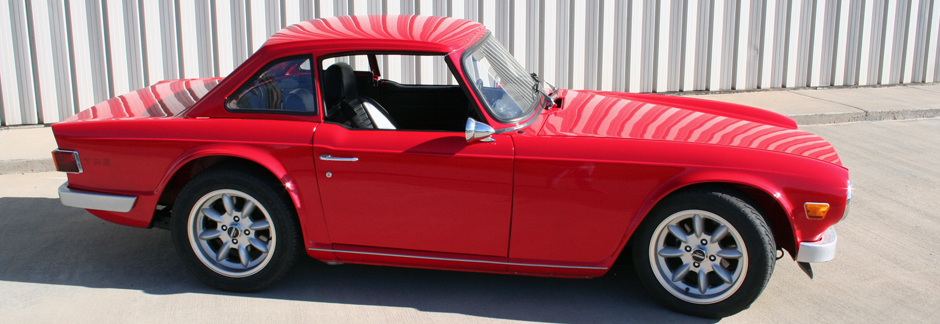
Well, the ECOTEC TR4 was built based on this premise.  If you look close enough at the photo above you will see things that are not in your average TR4:  for one, the hard top; then the bonnet is missing the ‘bulge’ and believe it or not, the boot lid is not ‘original’.  All of these three components have been hand crafted from aluminium.  To save even more weight, the glass in the hardtop shown above is not exactly glass…  It is plex.

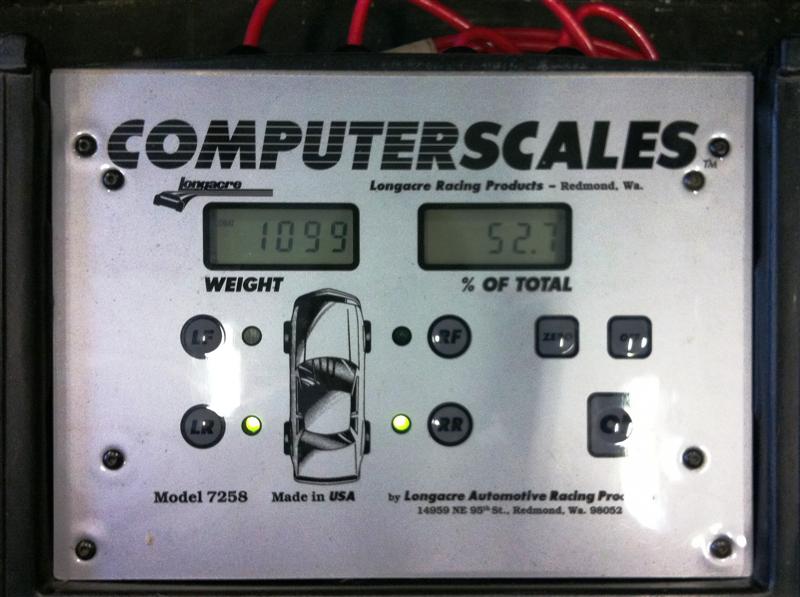
Close inspection of the pic above also shows the ECOTEC TR4 sitting on scales.  The silver case in the middle holds a Longacre automotive scale.  This is where things get interesting.  I’m sure you know where I’m going here.  So what is the total weight of this car?

Let’s start at the front, shall we?

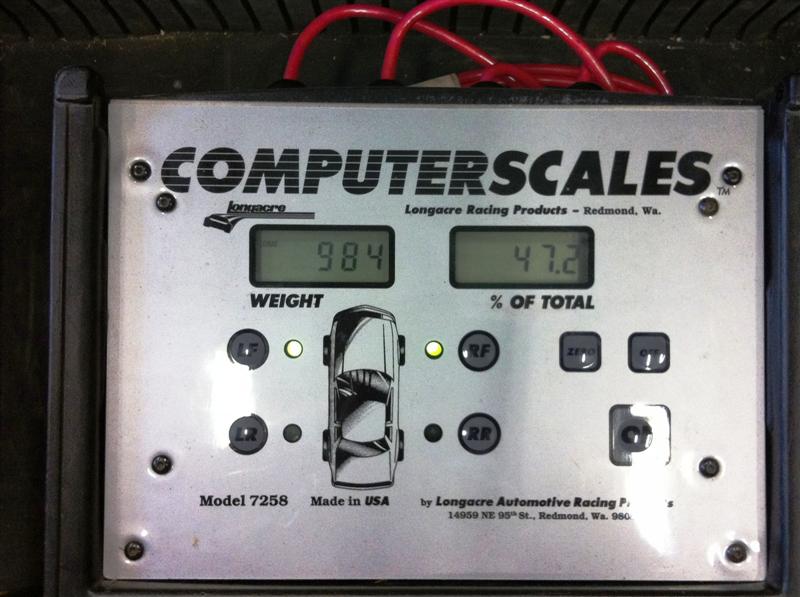
Front weight

That is it:  984 lbs, 47.2% of the total weight is on the front wheels.

Not let’s take a look at the rear:

Rear weight

That is 1099 lbs, 52.7% of total weight is on the rear wheels.

And finally, the total:

Total weight

Total weight:  2083 lbs.  Now keep in mind a few things:  the frame is brand new, made from scratch.  The ECOTEC is all aluminium and the car was put on  scales with an oversize fuel tank, 90% full.  Not bad huh?

Comments?  Questions?  Let me know…